
In June 2026, Google rolled out a dedicated Generative AI Performance report inside Search Console. It’s not a complete picture yet, and it isn’t available to everyone, but it’s the first time site owners have gotten any first-party visibility into how their content shows up inside AI Overviews, AI Mode, and AI-powered Discover.
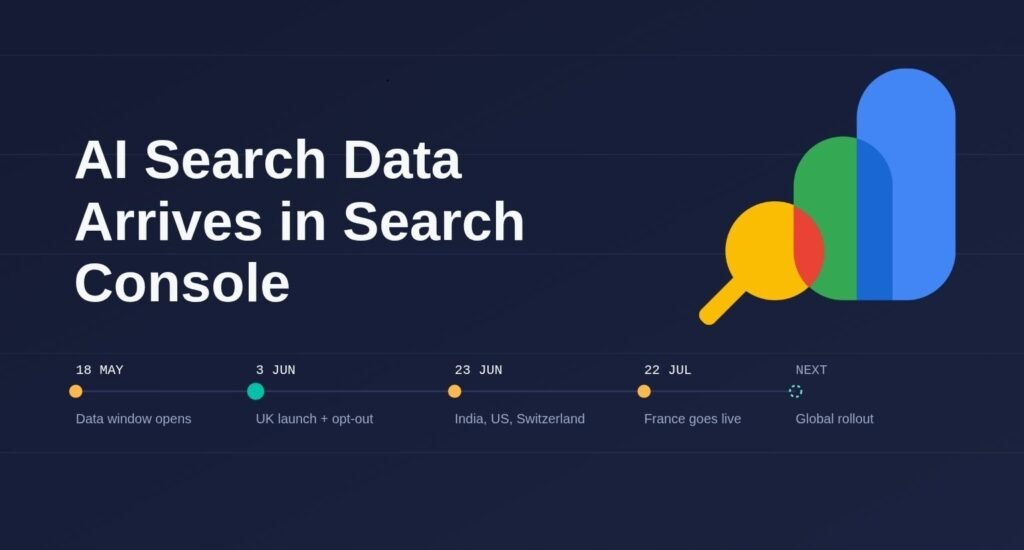
May 18, 2026 — The data clock starts: Google set this as the earliest date the new report can pull data from. There’s no historical backfill before it, so even sites that get early access won’t be able to look back further than this point. If you’re planning to use this data for trend analysis, treat mid-May 2026 as day one.
June 3, 2026 — Official launch: Google introduced two new reporting views inside Search Console: one covering AI Overviews and AI Mode within Search, and a separate one for AI-generated features inside Discover. Alongside the report, Google shipped a new opt-out control that lets site owners exclude their content from generative AI features entirely, without any impact on regular organic rankings.
This wasn’t a voluntary transparency gesture. It was largely a response to regulatory pressure — specifically the UK Competition and Markets Authority’s requirements under the Digital Markets, Competition and Consumers Act 2024, which pushed Google toward giving publishers genuine, auditable visibility and control over how their content is used in AI-generated answers.
June 3–17, 2026 — Limited UK beta: The rollout didn’t go global on day one. Google restricted initial access to a subset of UK-based site owners, framing it as a controlled test to gather feedback before scaling. The opt-out toggle followed shortly after, becoming fully effective on June 17, 2026.
Late June–July 2026 — Slow, uneven expansion: Access continued to trickle out beyond the UK in the following weeks, but inconsistently. Some site owners in other regions began seeing the report appear in their accounts, while many others — including large portions of the US market — still didn’t have it. Google gave no fixed schedule for when a given country or property would get access.
June 23, 2026 — India, the US, and Switzerland start seeing access: Roughly three weeks after launch, SEOs began reporting the report appearing outside the UK for the first time. Multiple practitioners with Indian-based properties confirmed access on non-UK sites, alongside reports from US-based properties and at least one Switzerland-based profile. Google did not announce this expansion formally — it surfaced organically through SEO community reports on X and Mastodon before being picked up more broadly. This matters because it shows Google’s rollout pattern: quiet, incremental, region-by-region, with no public changelog entry marking each expansion.
July 22, 2026 — France goes live: AI Overviews and AI Mode became available in France, and with that, French-language properties started seeing their AI impression data begin from essentially zero, since the underlying AI features themselves hadn’t been active there before.
Ongoing — expanding, but still not global: As of the most recent reports, access spans the UK, India, the US, Switzerland, and France, with more countries likely picking up access on the same quiet, unannounced basis. If your property isn’t showing the report yet, it doesn’t necessarily mean your country is excluded — check back periodically, since Google has been adding regions without formal announcements. A fully global rollout is still unconfirmed on any specific date. Under the UK regulatory deadline that triggered this whole initiative, Google has roughly nine months from the original mandate to implement the complete set of required controls, putting a hard deadline somewhere around March 2027 — though officials have indicated the more important pieces should land sooner than that.
Worth noting: Google isn’t first here: Bing Webmaster Tools already has its own Bing AI performance report (Launched on February 10, 2026), and unlike Google’s staged rollout, it launched available globally from the start — giving Bing’s version broader reach for months while Google was still limited to a UK subset. That’s a useful comparator if you’re managing multi-engine SEO reporting and wondering why your Bing AI data looks more complete than your Google AI data right now.
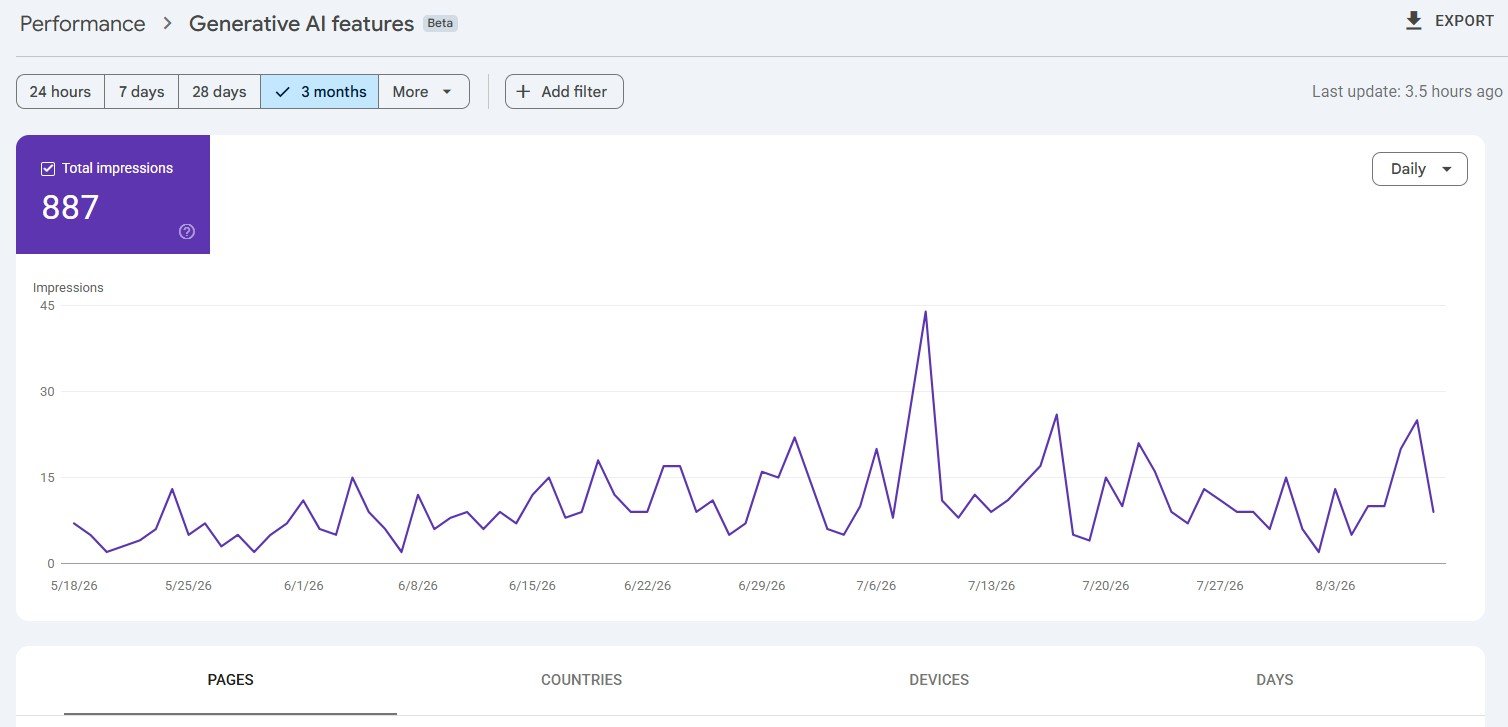
You’ll find it in the sidebar under Performance → Generative AI — it sits as its own sub-item beneath the main Performance report, alongside the regular Search results view, rather than as a separate top-level section.
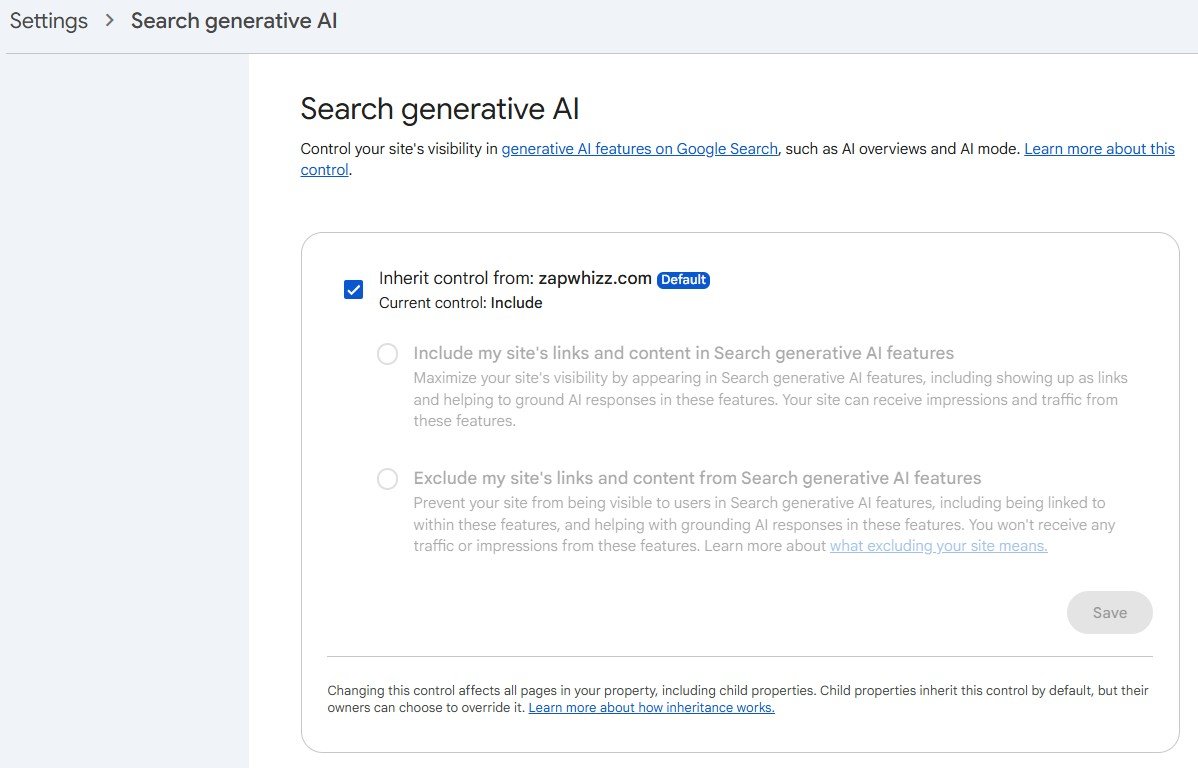
The control lives under Settings → Search generative AI inside Search Console. Once you open it, you get three options:
1. You finally get a partial answer to the “is AI eating my traffic” question. Impressions-only data isn’t the full picture, but it’s the first verifiable signal. If a page is racking up AI impressions while its organic clicks in the standard Performance report are flat or falling, that’s a real, attributable pattern worth investigating — not a hunch.
2. Page-level visibility opens the door to a new kind of content audit. Because the report tells you exactly which URLs are being pulled into AI features, you can start correlating content structure, format, and freshness with AI citation likelihood. Pages that get cited frequently are worth studying as internal case studies for what AI systems seem to favor.
3. The opt-out toggle is a genuinely new lever, not a repackaged old one. It’s easy to confuse this with existing controls, but it behaves differently from both of them:
4. Regional rollout gaps mean your data may be premature — don’t overreact. If your site operates across multiple markets, don’t assume flat or missing AI impression numbers mean your content isn’t being surfaced. It may simply mean your market hasn’t been switched on yet, or that the underlying AI feature itself hasn’t launched there (as was the case in France until July).
5. Treat this as the opening move, not the finished tool. Given Google’s own admission that clicks, queries, and API access are still missing, any AI-search strategy built purely on this report today will be incomplete. The realistic move is to start tracking the dimensions you do have now, so you’re building a clean historical baseline by the time richer data (especially clicks and queries) eventually ships.
Theory 1: It’s a PR move to counter the “Google is stealing our traffic” narrative. There’s a strong case here. The pressure on Google hasn’t been quiet. Pew Research data has shown that when an AI Overview appears at the top of a results page, only a small fraction of users click any of the underlying source links — a stark drop compared to results pages without one. Giving site owners a dashboard that shows “look, you’re still getting impressions” is a low-cost way to reframe the conversation from “you’re disappearing” to “you’re just being measured differently now.” Whether impressions without clicks actually reassure anyone is a separate question — but as an optics move, it’s efficient.
Theory 2: It’s a retention play against third-party AI-visibility tools. This one holds up well too. An entire category of tools has sprung up in the last year specifically to track brand and content mentions inside AI Overviews, ChatGPT, and other generative answers, because no first-party option existed. Every time a marketer opens one of those tools instead of Search Console, that’s a habit forming outside Google’s ecosystem — and habits are sticky. Shipping even a limited native version inside Search Console is a plausible defensive move to keep that workflow, and the accompanying keyword/traffic data around it, inside Google’s own product.
Theory 3: It’s about keeping SEO “reportable” as an industry, because Google needs SEOs to keep believing the game is winnable. This is a subtler angle but worth taking seriously. SEO as a discipline depends on the idea that effort produces measurable, attributable results. If a large and growing share of visibility becomes literally unmeasurable, the incentive for businesses to invest in content, technical SEO, and links weakens — and that investment is part of what keeps the web (and Google’s index) rich with content worth serving. A reportable AI layer, even a thin one, keeps SEO as a discipline feeling viable rather than obsolete.
Theory 4: It’s cover against allegations that AI Overviews are siphoning clicks by design. This is probably closer to the center of it than Google would say outright. The traffic numbers being cited by publishers this year are severe — some large news properties have reported organic traffic declines of 25% to over 80% year over year, and multiple major publishers have openly discussed blocking Google’s crawlers entirely rather than continuing to accept the current trade-off. Against that backdrop, a report that shows impressions (activity) without clicks (impact) is, cynically, a way to demonstrate “engagement” without having to surface the metric — click-through rate — that would actually confirm or deny the harm publishers are alleging. That omission is unlikely to be accidental at this stage of the product.
Theory 5: It’s a hedge against a wave of publishers blocking Google outright. This is arguably the most urgent driver of all. Through 2026, a growing list of major publishers and platforms — including outlets like the Associated Press, The Atlantic, and Condé Nast, alongside infrastructure providers like Cloudflare defaulting new customers to block AI scrapers — have moved toward restricting AI crawler access by default. Some publishers have gone further and openly discussed cutting off Google Search crawling entirely, not just AI training access, if the traffic trade-off doesn’t improve. If a critical mass of content providers actually pulled their content, Google’s AI features would have a lot less to summarize. Giving publishers a reporting layer and a clean opt-out is a way to keep them inside the tent — negotiating through settings rather than through robots.txt files and lawsuits.