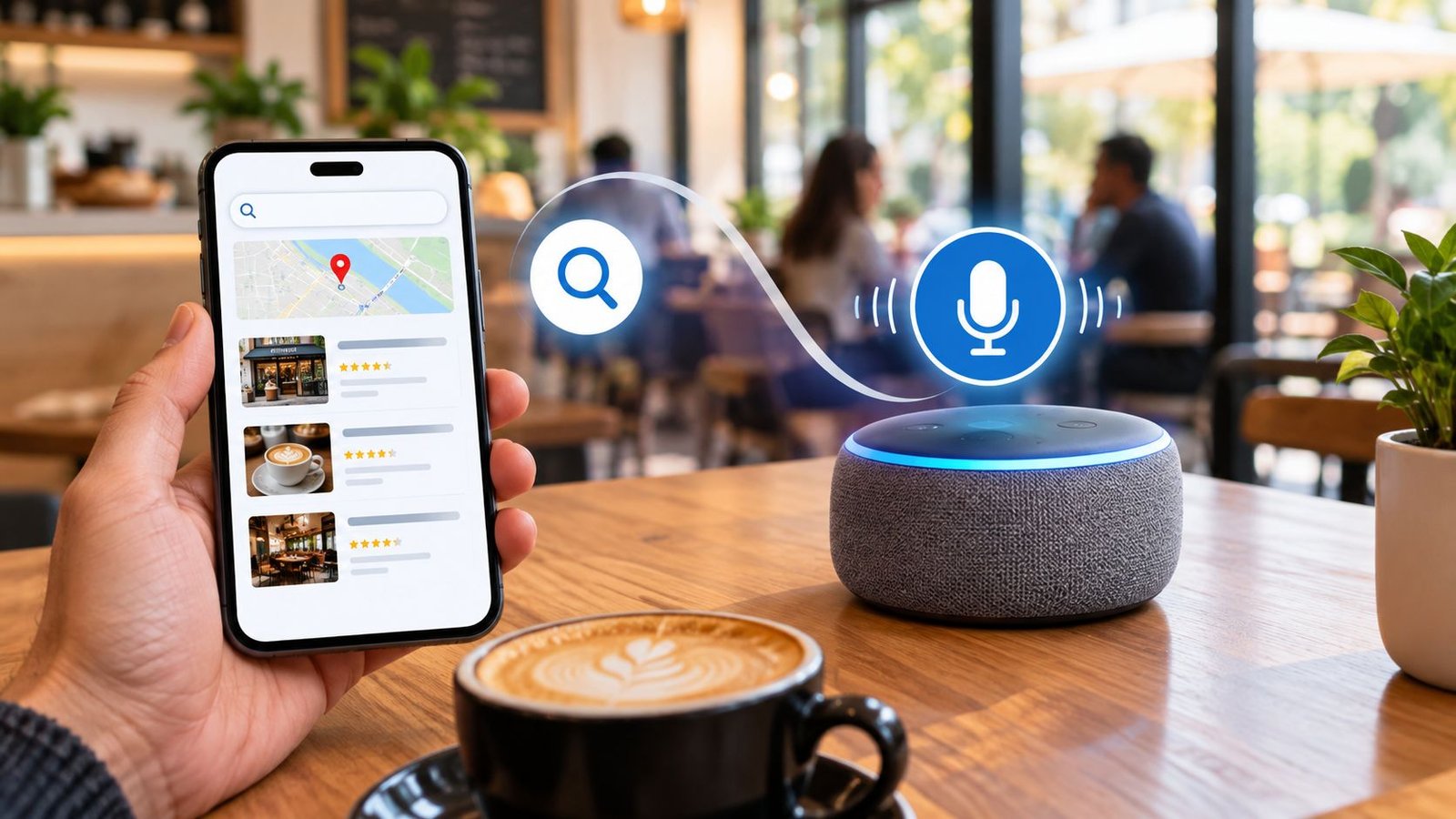
Search behavior is changing.
Rather than constantly entering search phrases like “coffee shop near me” into Google, consumers can just ask their phone, smart speaker, or car system to assist them in finding a nearby business.
For restaurants, cafés, bakeries, and other businesses operating locally, this is significant since voice searches usually contain conversational and geographical terms. A driver looking for a place to eat, a pedestrian exploring a neighbourhood, or a diner determining where to dine will all use voice commands.
Thus, local businesses should not consider voice search a rival to text search but rather ensure that their online presence fits both types of queries.
Voice search is especially important for businesses that rely on local consumers.
People may use voice commands to find:
For example, a user might type:
“Italian restaurant near me”
But when spoken, they may say:
“Where can I find a good Italian restaurant around here?”
The second question includes more context and is more conversational, which is preferred for businesses like restaurants and cafes, as the user may already be close to a purchase decision.
Text search is the traditional approach customers use search engines. One types terms or phrases and Google, Bing or another search domain provides relevant results. Examples are:
Customers often use them to compare, review, read menus, check prices, see images, and identify their options.
Voice search refers to searching by speech instead of writing.
The process of voice search can be performed through multiple devices: smart speakers, settings in cars, mobile phones, etc.
Usually, local voice searches look like this:
Unlike a traditional search results page, a voice-enabled system may provide a short answer or a small number of recommendations. Hence, ensuring your business continuity information is accurate and complete is especially crucial.
The key difference lies in the way queries are framed.
Text searches are usually short and keyword-specific.
In contrast, a voice search is more conversational and includes all essential details like location, working hours, preferences, or the services needed.
Search is evolving to a greater extent than ever. Today, searches have the capability to process long queries and allow users to ask follow-up questions.
Consider, for example, the question posed by a client:
“Find me a café nearby that’s open now.”
“Do they have outdoor seating?”
This indicates that businesses cannot just have a few words associated with them. They need to have clear and consistent content across all platforms.
Business listings and other information are being impacted by the advance of AI technology. As search engines are able to make sense of natural language, local businesses need to optimize their website and business profiles.
One does not need to establish an entirely new SEO plan to optimize for voice search.
Your Google Business Profile should contain accurate and complete information about your business.
Pay particular attention to:
Accurate hours are especially important for searches such as:
“Where is the nearest café open right now?”
If your profile includes hours that are no longer current, users may have wrong information about your business.
Google is not the only service that will help customers with finding local businesses. Depending on your place and industry, your company may also be visible on other services, like:
Variations in business data can lead to confusion for both customers and search systems.
Think about the questions a customer might say aloud.
Instead of creating content around only:
“Do you have outdoor seating?”
Other useful questions for a café or restaurant could include:
Answer these questions directly and naturally.
The challenge will be to incorporate the relevant keywords in a way that does not make the sentences sound forced.
An FAQ section can help you address common customer questions in a clear format.
Keep answers straightforward. If a customer asks whether you offer reservations, they should not have to read three paragraphs before finding the answer.
Q: Do you accept reservations?
A: “Yes. We accept reservations by phone and through our online booking system. Availability may vary during busy periods.”
Voice search and local SEO are closely connected.
You can also create useful local content, such as neighbourhood guides, local event information, or pages covering the areas your business serves.
Many voice searches are performed on mobile devices, so your website should work well on smaller screens.
Make sure visitors can quickly find:
Website speed, accessibility, HTTPS, and clear page structure are also important parts of a healthy website.
For local businesses, relevant structured data may include details such as:
Use the appropriate schema types for the information actually present on your website, rather than adding markup simply to target voice search.
If you own a café, restaurant, bakery, salon, repair company, or another local business, start with the basics.
Don’t optimize once and forget about it.
Review your business information periodically, update seasonal hours, add new photos when appropriate, respond to customer reviews, and test searches that potential customers might actually use.
Try speaking searches such as:
“Find a café near me that’s open now.”
“Where can I get breakfast nearby?”
“Which restaurants near me offer outdoor seating?”
Then check what information appears and whether your business is represented accurately.
Voice search should not be treated as a replacement for traditional search.
Customers still type searches when they want to compare several businesses, read detailed information, browse menus, look at photos, check reviews, or research a purchase.
Voice search is simply another way people interact with search engines.
Another person might ask:
“What’s a good coffee shop downtown that’s open right now?”
Both customers are looking for the same basic thing: a business that meets their needs.
Voice search is becoming an increasingly natural way for people to find local businesses, but it should be part of a broader local SEO strategy rather than a standalone tactic.
Cafés, restaurants, bakeries, and other local businesses should focus on accurate business information, useful website content, conversational FAQs, strong local SEO signals, and a complete Google Business Profile.
The key question isn’t simply “How do I rank for voice search?”
“Can customers easily find accurate answers about my business when they search in the way they naturally speak?”
If the answer is yes, you’re building an online presence that can serve customers across both traditional text searches and newer conversational search experiences.
I can also make this more SEO-focused for Appliance Genius, including appliance-repair examples and a natural internal link opportunity to your website, while keeping it suitable for third-party publishing.