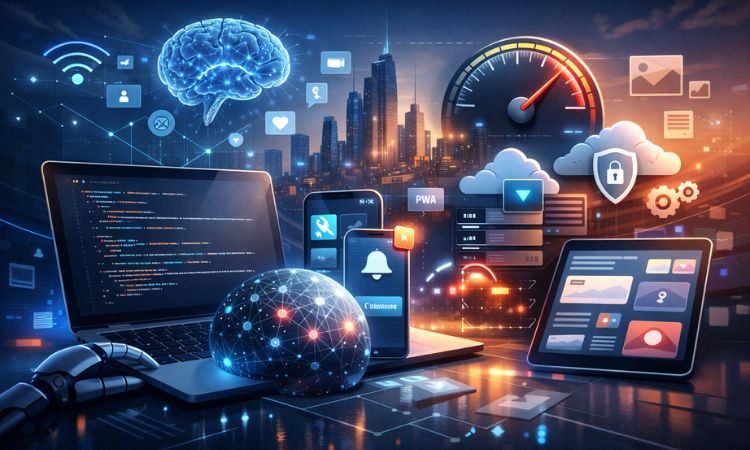
The days when web development was only about creating aesthetically pleasing sites are gone. For 2026 and beyond, web development will be about speed, experience, intelligence, and adaptability. It will be about creating smarter sites that load faster and engage people better.
If you’re a business owner, software developer, or IT expert, being aware of the trends listed above will help you stay one step ahead of the competition instead of just going along with the crowd.
Let’s delve deeper into the web development trends that will make a real impact in 2026.
In 2026, it is not optional. Your users expect pages to load in nearly an instant. If it takes longer than that, they are gone, regardless of how great it looks.
Contemporary web development has come to involve:
Search engines also give priority to fast-loading sites, thereby making site speed a strength for a business, not just an IT one.
Websites are becoming more responsive to behaviours. Instead of showing all users the same things, contemporary websites are dependent on:
“By 2026, websites will naturally lead visitors through their pages without coercion and with a natural behaviour that presents the visitor with what it is best for him to see when he sees it.”
“Mobile first” is no longer a trend but the norm. In the year 2026, mobile first design and scaling up will be the norm.
“If a website doesn’t feel good on a mobile phone, users just won’t stay,” Kate indicated.
Progressive Web Apps are also gaining popularity. These are basically an amalgamation of the strengths of web sites and mobile apps, but without the need to install anything.
By 2026, PWAs will gain popularity owing to:
It means improved user retention for businesses without the exorbitant cost involved in app creation.
Minimalism is undergoing a transformation. It’s not about empty space anymore, but about clarity.
Modern Sites in 2026 Will Emphasize:
It must be self-evident to visitors what the site has to offer and what their next step is.
Behind the scenes, the world of web development is undergoing rapid transformation. The growing adoption of headless architecture has made it possible to reap the following benefits:
In short, this means that content can now be shared across many different websites, apps, and even smart devices without rebuilding everything from the ground up.
By 2026, all websites must be accessible to everyone. This includes people with disabilities. It’s not just the law; it makes sense.
Developers are now using:
Accessible websites provide more users with a valuable experience.
The increasing risks associated with cyberspace mean that security is no longer a secondary consideration. The website of the year 2026 is designed with sequestration, or protection, in mind.
Drug users trust websites which admire their information, as trust leads to fidelity.
The “no-code” and “low-code” development tools are gaining popularity, but they won’t be replacing programmers anytime soon because they’ll be used to speed up the repetition process so that more time can be devoted to programming logic, performance, and personalization.
In 2026, the most effective approaches include:
The web in 2026 requires web development that transforms the website into a human-like application, loads fast, and also adapts quickly. This is not about the trends, but about the development of web experiences that work for the users.
Those companies that spend on better web development will be forefront. Those that do not will just fade away.
“The future of the Web is not complicated—it’s smart, simple, and user-centric.”