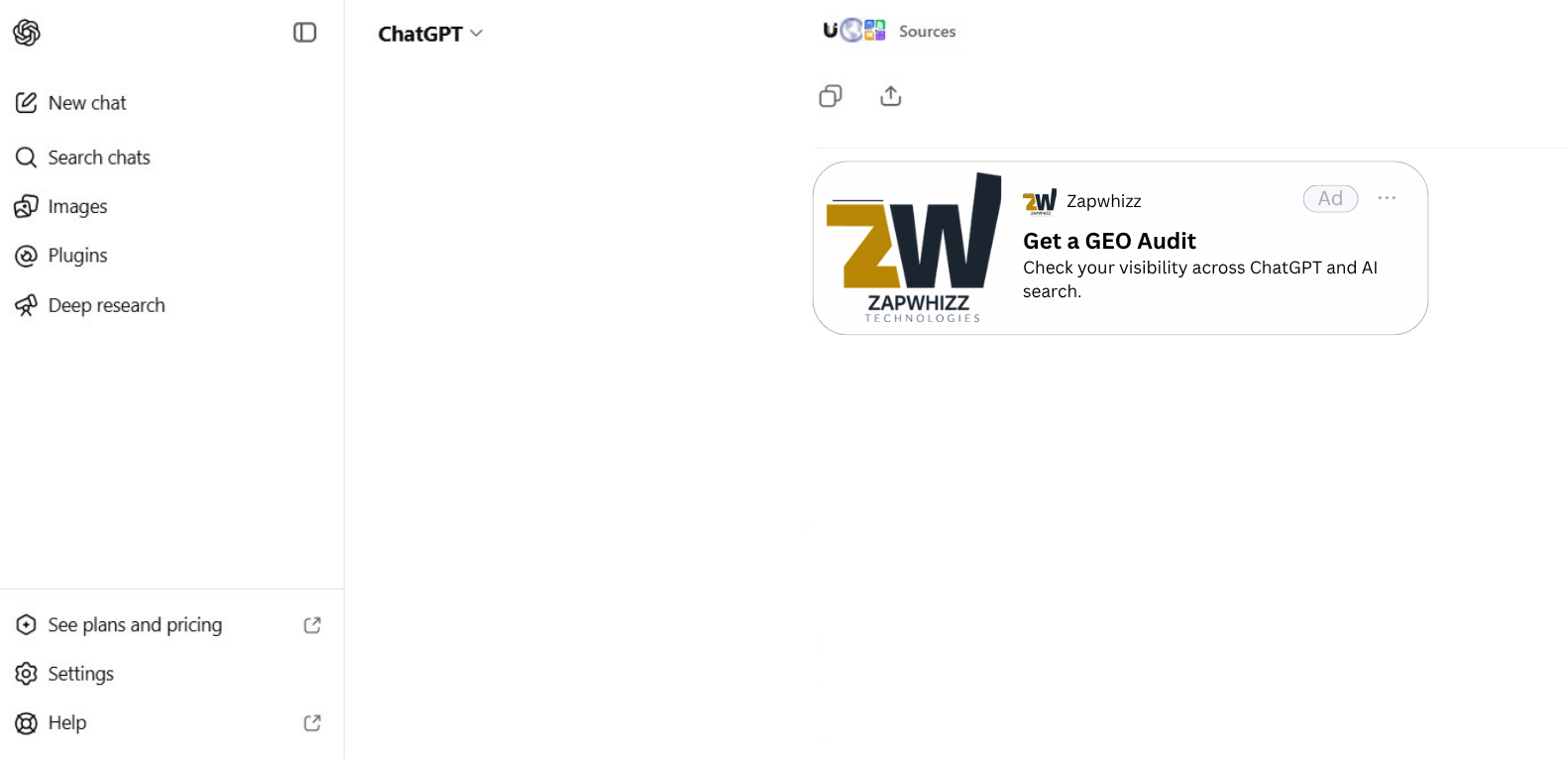
With ads beginning to appear on the widely used conversational AI platform ChatGPT by February 2026 and since extending to numerous countries including India in August, the development has prompted many queries about their functioning, eligibility for showing and the potential effect these sponsored texts have on the model’s output.
In India the ads arrived later in August 2026 followed by the availability of the self-serve Ads Manager four weeks later on September 4.
Unlike their poorer counterparts, users on higher-tier plans such as Plus, Pro, Business, Enterprise, and Education continue to access an ad-free experience.
Ads are displayed primarily for logged-in Free and Go plan users; however, in many countries these are also available for logged out, guest users too. As these guests neither possess a profile nor historical interaction with the AI, their ads would lean towards general, more universally-acclaimed topics and not specific. There is no presence of ads for those who are flagged as below the age of 18 (as dictated by the age information users provide while creating their account or through age prediction algorithms) nor adjacent to topics related to health, mental-health, politics, or those deemed sensitive.
Ads in ChatGPT always appear at the end of your response and are not intertwined with the answer itself. These sponsored texts are accompanied by a clear ‘Sponsored’ label so as not to be confused with any AI responses and are presented visually separate from your actual dialogue. OpenAI has repeatedly insisted, by way of both statement and design, that advertisements are an addendum to, not an influencer of, the answer produced by ChatGPT’s natural language processing and artificial intelligence; the core responses remain unaffected.
The sole factor for determining which ad gets delivered to you now on ChatGPT and later by September, is solely the context of your current conversation, where a search about travel could get you deals related to travel websites, productivity tools would present the user with relevant software. With personalization enabled on your end, ChatGPT utilizes prior conversations and information it is privy to through Memory to make ads that fit your preferences though your interactions themselves are neither relayed nor visible to third parties; all the advertisers can access is an overall report of how their ads are performing based on impressions, and click-through rates. As for your unlogged-in guests, ads are tailored exclusively based on their current prompt.
The company has integrated several safeguards to manage your privacy. Besides the absence of any disclosure of your chat history, personal details, and Memory content to anyone or any entity; these include toggling your personalized ad experience on/off, wiping the accumulated data which could be related to ads, and disregarding individual ads you may wish not to be associated with as well as relaying feedback for each one to OpenAI. These options may vary in availability but are usually found beneath your settings/account configuration under Ad/Data control sections.
Operating at scale with language models requires resources, both computational and developmental, and for a large segment of its user-base on free plans and those requiring low financial outlay, it appears that advertisements help offset the extensive overhead without necessarily placing an over-reliance on premium subscription schemes, all while keeping the free version accessible.
ChatGPT ads are an explicit new path in terms of monetizing the ChatGPT platform itself, and will be positioned separate from the actual responses as well as offering the user some form of control.
As these ads spread it’s unclear how well the delicate balance between free and accessible answers, and advertising and the users privacy will remain but for now visit OpenAI for the up to date, official word.